



The sustainable management of groundwater resources is critical to the economic, social, and environmental fabric in the Sacramento Valley and is an essential element of ridgetop to river mouth water management. Through the Northern California Water Association (NCWA), there is a concerted effort to bring the region together to actively manage our water resources—both surface and groundwater—for multiple benefits that ensure sustainable water supplies for cities and rural communities, farms, fish, birds, recreation, and hydropower. Groundwater resources are critical to the region, with groundwater providing nearly 30% of the region’s water supplies, with this percentage increasing during dry years and during sustained droughts.
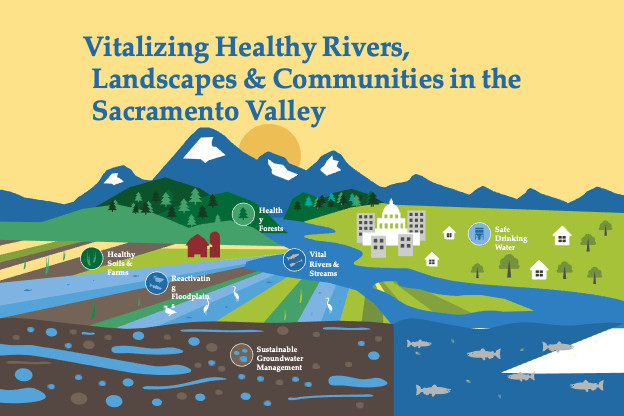
As part of ongoing efforts to achieve sustainability, water leaders throughout the Sacramento Valley have made a concerted effort over the past decade to assess Sacramento Valley groundwater resources, both for groundwater levels and quality—and to then actively manage our water resources—both surface and groundwater—to assure sustainable water supplies for all the purposes described above.
In A Pathway for the Future: Sustainable Groundwater Management in the Sacramento Valley, we offer a path forward for groundwater sustainability in the Sacramento Valley and call upon the leaders in the region to utilize our extensive and valuable natural infrastructure, including the groundwater aquifers and recharge areas, as part of a healthy landscape necessary for a functional Sacramento Valley and greater water supply resilience. The objective is to support GSAs (counties, cities, water agencies and other special districts) and landowners throughout the region to help them create stronger local institutional capacity for GSAs while implementing the foundational GSPs for the Sacramento Valley, including coordinating efforts across the Valley floor, providing education, and fostering mutual respect among agencies. Active management by GSAs through the GSPs across the entire Sacramento Valley floor will be essential for our aquifers and regional sustainability.
NCWA, through the leadership of its Board of Directors, will continue to convene Groundwater Management Task Force to coordinate groundwater management and to help implement regional approaches to implementation. Our objective is to continually learn and better understand the water resources in the region and use this information to actively manage our water resources—both surface water and groundwater—to ensure sustainable water supplies from ridgetop to river mouth.
For additional information on Sacramento Valley groundwater resources, see: